The kobza is more than a musical instrument. Its strings carry centuries of Ukrainian history, storytelling and cultural identity. Historically associated with travelling musicians known as kobzars, it helped preserve songs, stories and collective memory across generations. At a time when war and displacement continue to threaten Ukrainian cultural heritage, documenting and sharing the sound of the kobza has acquired renewed importance.
This Kontakt library is part of a project I have undertaken with a colleague from Newcastle College University Centre, with the help of a friend whose family are participants of this unbroken yet threatened with extinction tradition, and who brought with them the instrument to the UK. Together, we are exploring how modern recording, production and sampling techniques can help preserve the character of this historic instrument while making it accessible to contemporary composers, producers, students and musicians.
The aim is not simply to record a few representative notes and distribute them across a keyboard. We intend to sample the kobza systematically and in considerable depth for the best part of the 2026-2027 term. The proposed methodology involves recording every playable note, alongside the possible note combinations and performance techniques that could reasonably be expected when playing the instrument. These will be captured at multiple velocities so that the library responds naturally to differences in touch and intensity rather than producing the same static sound regardless of how it is played.
Where appropriate, the recording process will include individual plucks, sustained tones, tremolo, harmonics, muted playing and other characteristic articulations. Chords, intervals and sympathetic interactions between strings will also be considered, as the sound of several strings resonating together cannot always be reproduced convincingly by layering isolated samples. Capturing these combinations should preserve more of the kobza’s natural resonance, movement and tonal complexity.
Recording at a range of velocities will be particularly important. A gently played string does not merely sound like a quieter version of a forcefully played one. The attack, brightness, resonance and balance of overtones can all change according to the strength and manner of the performance. Sampling these variations will allow the finished instrument to react more expressively and retain more of the character of the original kobza.
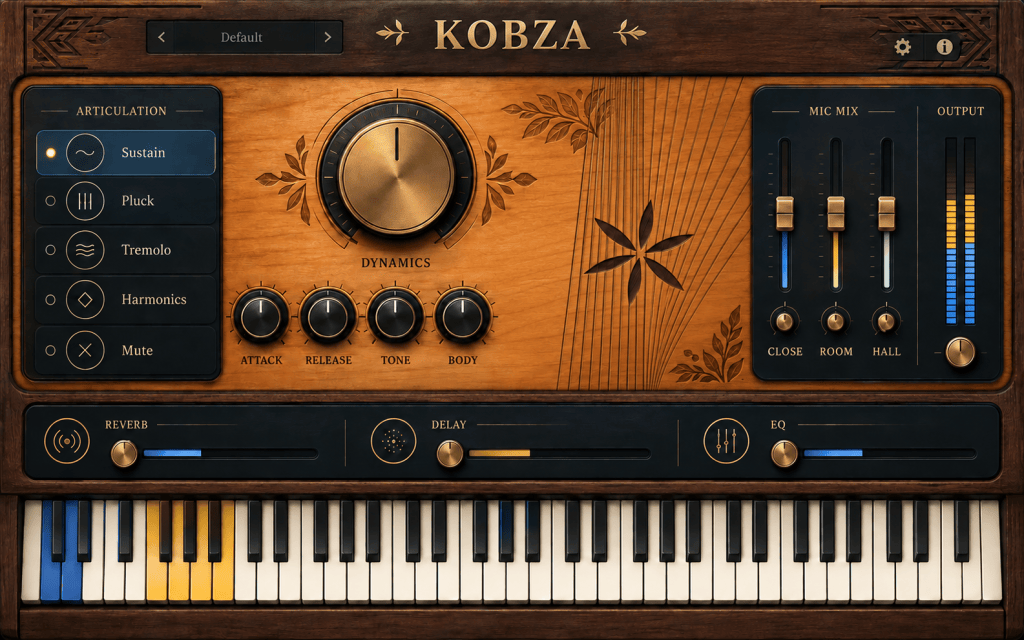
Once recorded, the samples will be carefully edited, organised and mapped within Kontakt. The interface will provide practical control over dynamics, attack, release, tone and body, together with microphone and ambience options. The intention is to make the library detailed enough for serious composition while remaining intuitive for musicians who may be discovering the kobza for the first time.
The project sits at the meeting point between preservation and experimentation. A sampled library can never replace the presence, interpretation and individuality of a skilled kobza player. It can, however, document the instrument’s sound, broaden access to it and encourage its use in new musical settings. Through careful sampling, the kobza could find a place in film and game scores, contemporary songs, experimental work and new compositions by Ukrainian musicians and composers around the world.
Technology alone cannot preserve a musical tradition. That work ultimately belongs to performers, instrument makers, researchers, educators and communities who understand its history and meaning. Technology can nevertheless provide another means of recording, sharing and carrying that tradition forward.
This Kontakt library is therefore intended to be both a practical musical instrument and a contribution to the preservation of Ukrainian cultural heritage. By documenting the kobza in detail and presenting it in an accessible digital form, we hope to honour its history without confining it to the past, allowing its distinctive voice to continue resonating through new music.


Leave a comment